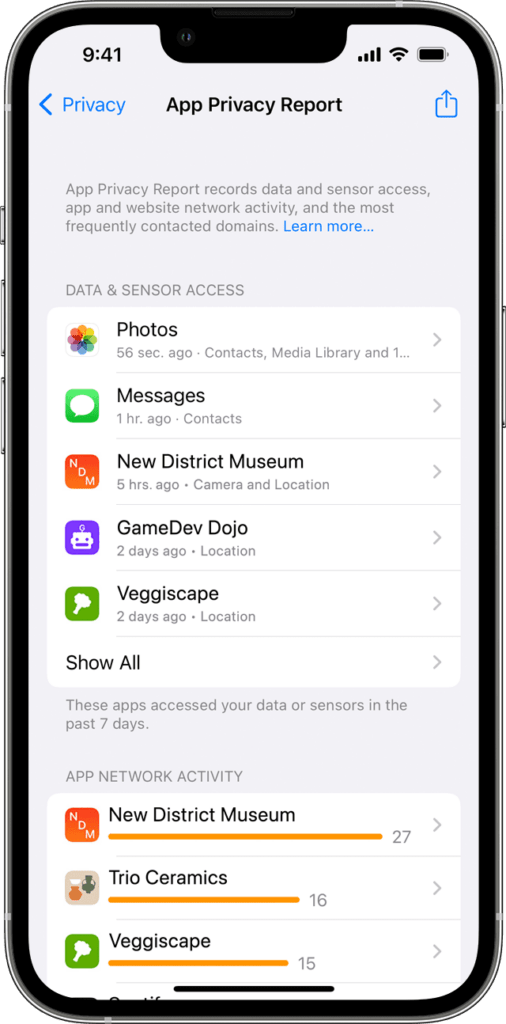
App Privacy Report: What Your Apple Device Is Actually Doing

Switch it on, wait a day, then look for the entries that make no sense: the calculator with location access, the domain your phone talks to all night. Useful for spotting outliers, poor at everything else.

Apple's App Privacy Report records how apps use the permissions you have granted them and which domains they contact. It is off by default and it only logs from the moment you enable it, so switching it on today gives you nothing until tomorrow.

Turning it on

Settings → Privacy & SecurityApp Privacy ReportTurn on App Privacy Report. It sits near the bottom of the Privacy & Security list.

This pane was called simply Privacy on older iOS releases, which is why guides written a few years ago point at a menu name that no longer exists. The feature itself arrived in iOS 15.2.

Return to the same path to read the report. Give it a day of ordinary use first.

What it records

Apple documents two things. Data and Sensor Access shows how often apps reached your location, camera, microphone, photos and contacts over the past seven days. Network Activity shows the domains contacted by apps, the domains contacted by websites inside those apps, and which domains were contacted most often.

Seven days is the retention window. It is a rolling snapshot, not an archive.

What it is actually good for

The honest assessment has not changed since this guide was first written: as a whole the report is difficult to act on. Domain lists are mostly content delivery networks and analytics endpoints with names that tell you nothing, and there is no way to block anything from within the report.

The Data and Sensor Access half is the useful half, and it is useful in one specific way: it surfaces outliers. Not the app you expect to use your microphone, but the one you do not. A calculator with location access. A game reaching contacts. A utility talking to a domain all night while you sleep.

Use it as a prompt rather than a dashboard. Switch it on, wait a day, skim for the entries that make no sense, then act on those through Settings → Privacy & Security, where the sensor lists let you revoke access directly.

What it does not show

The report covers permissioned access and network destinations. It does not show what was inside those connections, does not attribute data to a purpose, and does not cover anything an app collected before you enabled it. A quiet domain list is not evidence that an app is well behaved, only that it is not noisy.

Verified against Apple support documentation on 17 August 2026. Menu names vary by OS version and by manufacturer skin, so if a step does not match your device, search Settings for the bolded term rather than following the path blind.

Subscribe to SparkForge

Don’t miss out on the latest issues. Sign up now to get access to the library of members-only issues.
jamie@example.com
Subscribe