Intervening in the Attribution Chain
Attribution is a process, not a condition. It runs observation, collection, correlation, identity, and a countermeasure that fires at the wrong stage leaves everything downstream intact.
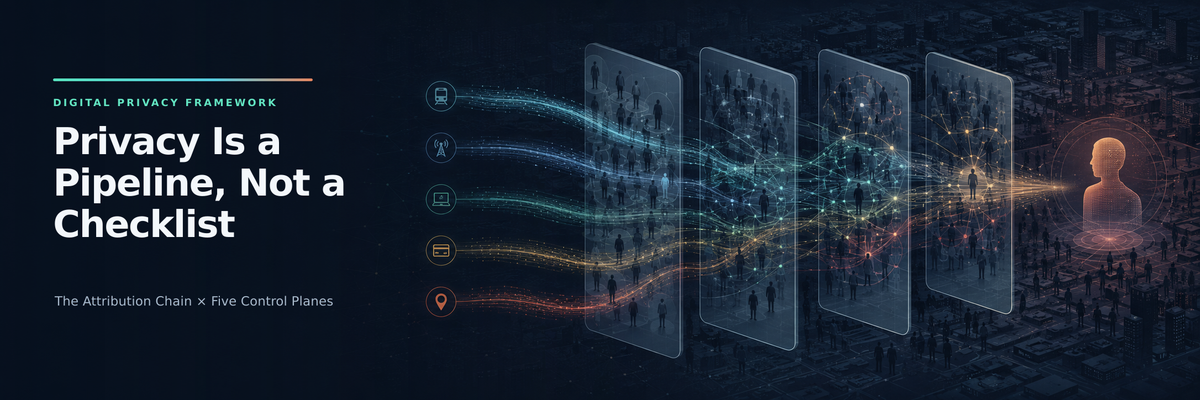
Most privacy advice is a list. Use a password manager, use a VPN, freeze your credit, turn off ad tracking, put the phone in a bag. The list is not wrong. It is unordered, and unordered lists hide what you most need to know: what happens after any single item on the list fails.
A body of doctrine published between December 2025 and August 2026, mostly in Small Wars Journal and mostly by Christopher Moede, offers a way to order it. The argument is that attribution is not a condition you are either in or out of. It is a pipeline the adversary runs, with stages, and each stage takes the previous stage's output as input. That structural claim converts a flat list of measures into a sequence with a known failure order.
SparkForge readers already have a framework for this material: the Five Control Planes, which partition governable surface area into Transportation, Phones, Internet, Money, and Location/Facility. The planes answer the question "what do I control?" The attribution chain answers a different question: "when does my intervention land?" Neither framework answers the other's question. Crossing them produces something more useful than either.
THE CORE IDEA. The Five Control Planes are domains. The attribution chain is a sequence. Planes are columns, stages are rows, and every countermeasure you own occupies exactly one cell. If you cannot say which cell, you cannot say what survives when the measure fails.
The chain, as published.
Moede's May 2026 piece, Intervening in the Attribution Chain, models exposure in four stages.
Observation. "Observable behavior is first detected by sensors in everyday systems, across financial networks, travel, communications platforms, physical surveillance, and other vectors." The intervention here is to shape the behavior's distinctiveness and frequency. Not to hide it, which is usually impossible, but to make it unremarkable or to not generate it.
Collection. "These observations are then collected and aggregated within commercial surveillance ecosystems... across multiple databases, jurisdictions, and geographic locations." The intervention is to avoid creating stable identifiers that link physical and digital artifacts across contexts.
Correlation. "The observable behavior is now accessible for analytical systems and human analysts to correlate in search of patterns, linking physical and digital artifacts across domains." The intervention is to "fragment, distort, or overload the narrative that correlation attempts to construct."
Attribution. "Attribution is what occurs when correlation of data that was observed and collected earlier becomes confidence." The intervention is to maintain competing plausible narratives, preserving ambiguity about identity and intent.
The load-bearing sentence in the piece is not any of the stage definitions. It is this: "One operational mistake is typically insufficient to expose an entire operation. Exposure increasingly emerges not from a single detectable act but from aggregation." Moede compressed the same idea in his April 2026 analysis of GRU tradecraft failures, where discrete artifacts are "individually... risky but not necessarily compromising," yet "aggregated and correlated across vectors in the digital domain, however, they paint a compelling operational picture."
The Institute for Signature Reduction, the 501(c)(3) Moede directs, formalizes the same staging under the label attribution pressure, which it defines as "the cumulative pressure on an operator's identity, relationships, location, and intent, built through cross-domain observability and correlation," and which "builds in stages: observation, collection, correlation, attribution."
Note what the doctrine does not claim. It does not claim you can stop being observed. Moede's stated objective is "a sort of non-distinctiveness which affords us maneuver in the gray zone," and ISR states plainly that the goal is "preserved freedom for action and operational maneuver, not invisibility." That logic transfers to anyone whose threat model involves being one of many rather than being absent.
Crossing the two Frameworks.
Put the planes across the top and the stages down the side. Every countermeasure lands in one cell.
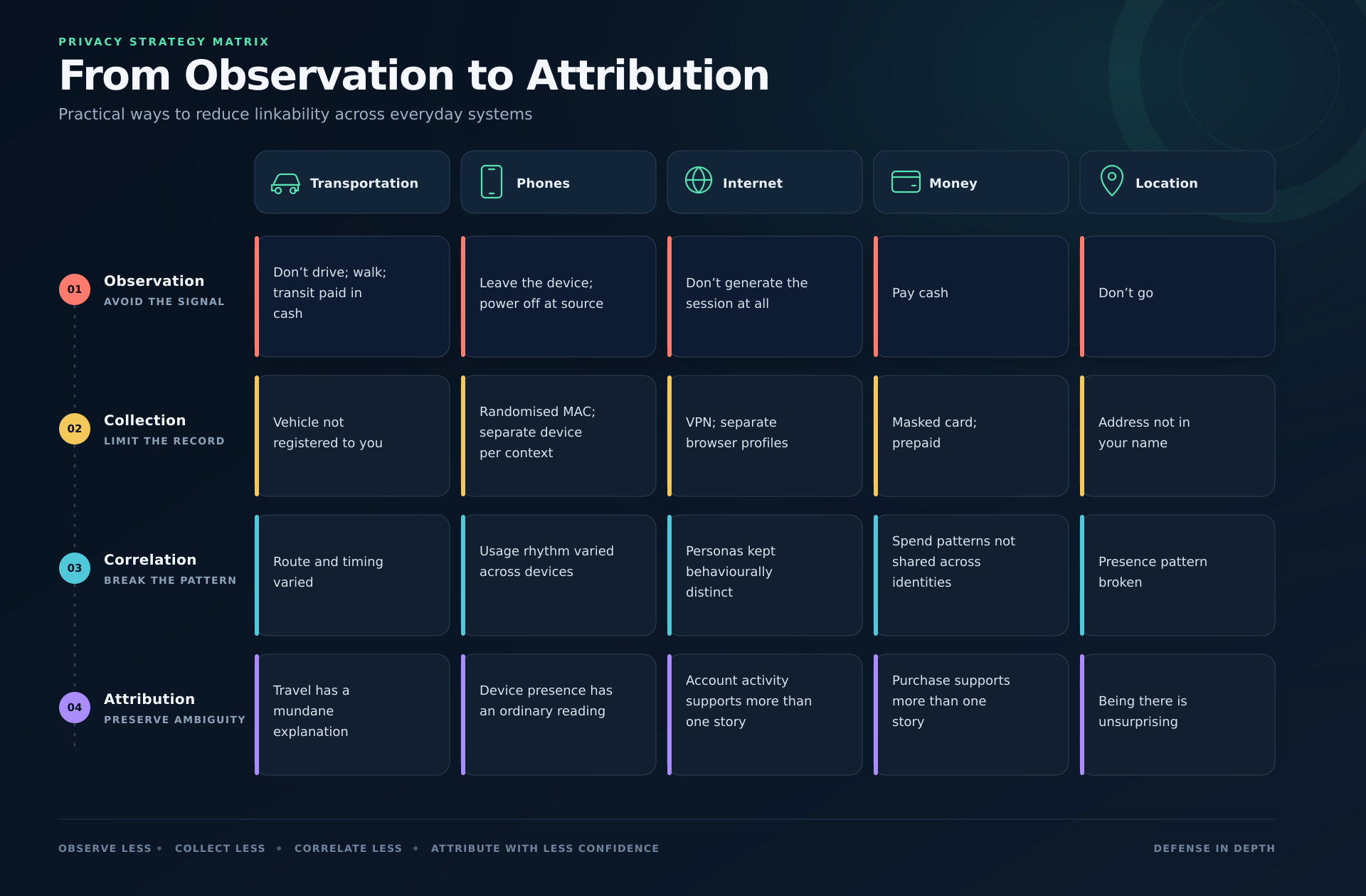
The value of the table is not the table. Filling it in for your own life forces you to place each measure you actually use, and it's often not where you assumed.
Working examples.
Money: cash versus a masked card. These feel like the same kind of measure. They are not. Paying cash is an observation-stage intervention. No card transaction occurs, so nothing enters the payment rails, and downstream stages have no financial record of that purchase to work with. A masked or virtual card is a collection-stage intervention. The transaction is still fully observed. The merchant, the acquirer, and the network all see that a purchase of a specific amount happened at a specific place and time. What the masked card breaks is the identifier. The merchant receives a card number that doesn't link to your bank account or to your other purchases.
The scoping is tighter than most users assume. Privacy.com's own documentation states that the merchant receives "the 16-digit Card number, expiration date, CVV, and billing address entered at checkout," and that "the merchant will also see your name when you provide it during checkout." The card number identifier is broken. The name identifier, if you type your name into the form, is not. A collection-stage intervention breaks the specific identifier it was designed to break and nothing else. If the merchant is breached, the transaction is still in the dump, along with whatever name and address you supplied. The cash purchase is not in the dump because it was never observed.
Internet: the VPN. Most people file a VPN as an observation-stage measure, as though it makes the browsing not happen. It is squarely collection-stage. Your ISP still observes that you generated encrypted traffic, in what volume, at what times, to an endpoint it can identify as a VPN provider. The destination site still observes a session with all its behavioral characteristics. What the VPN breaks is the IP address as a linking identifier between the two. That is genuinely valuable, and it is also narrow, which is why browser fingerprinting defeats it so easily. Fingerprinting reconstructs a stable identifier from the session characteristics the VPN never touched, and it operates at exactly the same stage. Two collection-stage measures in opposition, with nothing upstream of either.
Phones: three different stages, three different measures. Leaving the phone at home is observation-stage. No connection to the tower, no record generated, nothing downstream. Powering it off is weaker but still observation-stage, and it produces its own artifact, since a device that goes dark at consistent times has generated a pattern. Using a second device for a separate context is collection-stage. Both devices are observed by the network, and the intervention is that no stable identifier ties them together, which holds only until the two devices are co-located often enough for correlation to tie them by geometry rather than by identifier. Apple's own security documentation notes that a private Wi-Fi address can be "turned off by a device management service," reminding us that collection-stage protections often sit on infrastructure you do not control.
Transportation: the plate is not negotiable. A license plate is designed to be observed. No collection-stage measure unreads it. Registering a vehicle to an entity rather than to yourself is a collection-stage intervention that breaks the identifier linking plate to person, and it is undone the moment anyone associates you with the entity. Varying route and timing is correlation-stage, because it does not prevent any single read; it degrades the pattern that reads assemble into. Not driving is the observation-stage move, and it is the only one that stops the sensor from firing.
KEY TAKEAWAY. Ask of every measure: does this stop the sensor from firing, break the identifier, degrade the pattern, or supply an alternative story? Those are the only four answers, and they are not interchangeable.
Why late interventions are weaker.
The stages are not equally strong, and the reason is structural rather than a matter of technique. Each stage inherits everything the previous stage resolved. An observation-stage intervention denies the pipeline its input, so nothing downstream can operate on data that does not exist. An attribution-stage intervention is arguing about the interpretation of a record that is complete, permanent, and already correlated.
Consider a masked card that fails, in the sense that the merchant is breached and the transaction surfaces in a broker's dataset alongside your name and shipping address. The transaction, amount, timestamp, and merchant were all resolved at stage one. The collection-stage measure was the only thing standing between them and you, and it was a single point of failure. Now consider a cash purchase. No failure mode at stage one can retroactively create the record. The measure either happened or it did not.
This also explains why maintaining competing plausible narratives, the stage-four intervention, feels unsatisfying to technical readers. It is not a technical control. It cannot be. By the time you are at stage four, every technical fact is already established, and the only remaining variable is what the facts are taken to mean. Moede is honest about where the leverage actually sits, arguing that human judgment is "the decisive factor which informs operational outcomes" at the correlation stage. In his February 2026 piece, he adds the necessary counterweight to automated analysis: "for all its pressure, correlation does not equal understanding."
THE ONE-LINE LESSON. Every stage you let the chain complete is a stage whose output you can no longer take back.
The clustering problem
Here is the finding that should change how you audit yourself. Take the measures a competent, privacy-aware person actually runs. VPN. Password manager with unique credentials per site. Masked cards. Separate email aliases per service. Randomized MAC. Ad ID disabled. Now place each one in the matrix.
Almost all of them land in the collection row.
That is not a coincidence. Collection-stage measures are the ones you can sell as products, install once, and leave running, because they operate on identifiers rather than behavior. Observation-stage measures require you not to do things. Correlation-stage measures require sustained behavioral discipline over months. Attribution-stage measures require thinking about how you look to someone who already has the file. You can't buy any of those three.
As a result, many people have a chain that is strong in exactly one row and empty in the other three. Since the stages are sequential and cumulative, the chain resolves at the weakest stage. Full observation feeding a single collection-stage barrier means every collection failure passes straight through to correlation with a complete record behind it. Aggregation, as Moede puts it, begets attribution.
A second-order trap sits in the same place. Countermeasures are themselves observable, and a distinctive countermeasure profile is a signature. The person paying cash for everything in a card-default environment, or presenting an unusually sanitized browser fingerprint, has not reduced their signature. They have created a rare one. This is precisely why the doctrine targets non-distinctiveness rather than invisibility, and why ISR frames the objective as ensuring collected data "remains uninteresting and generally insignificant." Absence is conspicuous. Ordinariness is not.
THE MINDSET SHIFT. Stop asking whether a measure is good. Ask which stage it intervenes at, what remains resolved if it fails, and whether the measure itself is the most distinctive thing about you.
What to actually do with this
Draw the grid. Five plane columns, four stage rows. Write every privacy measure you currently run into a cell. This takes twenty minutes, and it is the whole exercise. The empty rows are your answer.
Add at least one observation-stage habit per plane, because that row is almost certainly empty and it is the strongest row. On Money, that means a standing cash floor, a threshold below which you simply do not use a card. On Phones, it means routine, unremarkable periods where the device is genuinely elsewhere rather than powered off in your pocket. On Transportation, it means some trips that generate no vehicle read at all. These are behavioral, not purchasable, so they get skipped.
For every collection-stage tool you rely on, name the exact identifier it breaks and the identifiers it leaves intact. A VPN breaks IP and leaves fingerprint. A masked card breaks the card number and leaves the name you typed. A separate device breaks the hardware identifier and leaves co-location. Write the second half of each sentence down. That half is your residual exposure, and it is what resolves downstream.
Vary the rhythm, not just the identifiers. Correlation feeds on regularity. Same purchase, same day, same route, same hour is a pattern that survives every identifier you break, because the pattern comes from timing rather than names. Introducing genuine irregularity in when and how often you do routine things is the cheapest correlation-stage measure available.
Check that your countermeasures are common. If the way you protect yourself is rarer than the behavior it protects, you have moved your distinctiveness rather than removed it. Prefer defaults that large populations also run. A private Wi-Fi address that every iPhone uses is better cover than a bespoke configuration that only you use.
Rehearse the mundane explanation. For the handful of activities that genuinely matter to you, ask what an analyst holding the complete record would conclude, and whether a second, ordinary reading is available on the facts as they will actually appear. If only one story fits, the stage-four intervention isn't there, and you should spend your effort further up the chain, where leverage still exists.